Welcome to one of the most active flamenco sites on the Internet. Guests can read most posts but if you want to participate click here to register.
This site is dedicated to the memory of Paco de Lucía, Ron Mitchell, Guy Williams, Linda Elvira, Philip John Lee, Craig Eros, Ben Woods, David Serva, Tom Blackshear and Sean O'Brien who went ahead of us.
We receive 12,200 visitors a month from 200 countries and 1.7 million page impressions a year. To advertise on this site please contact us.
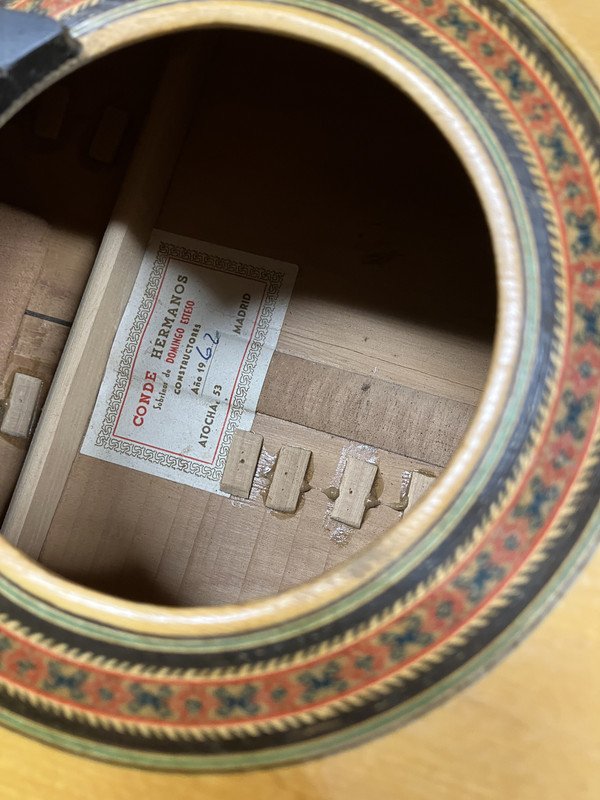
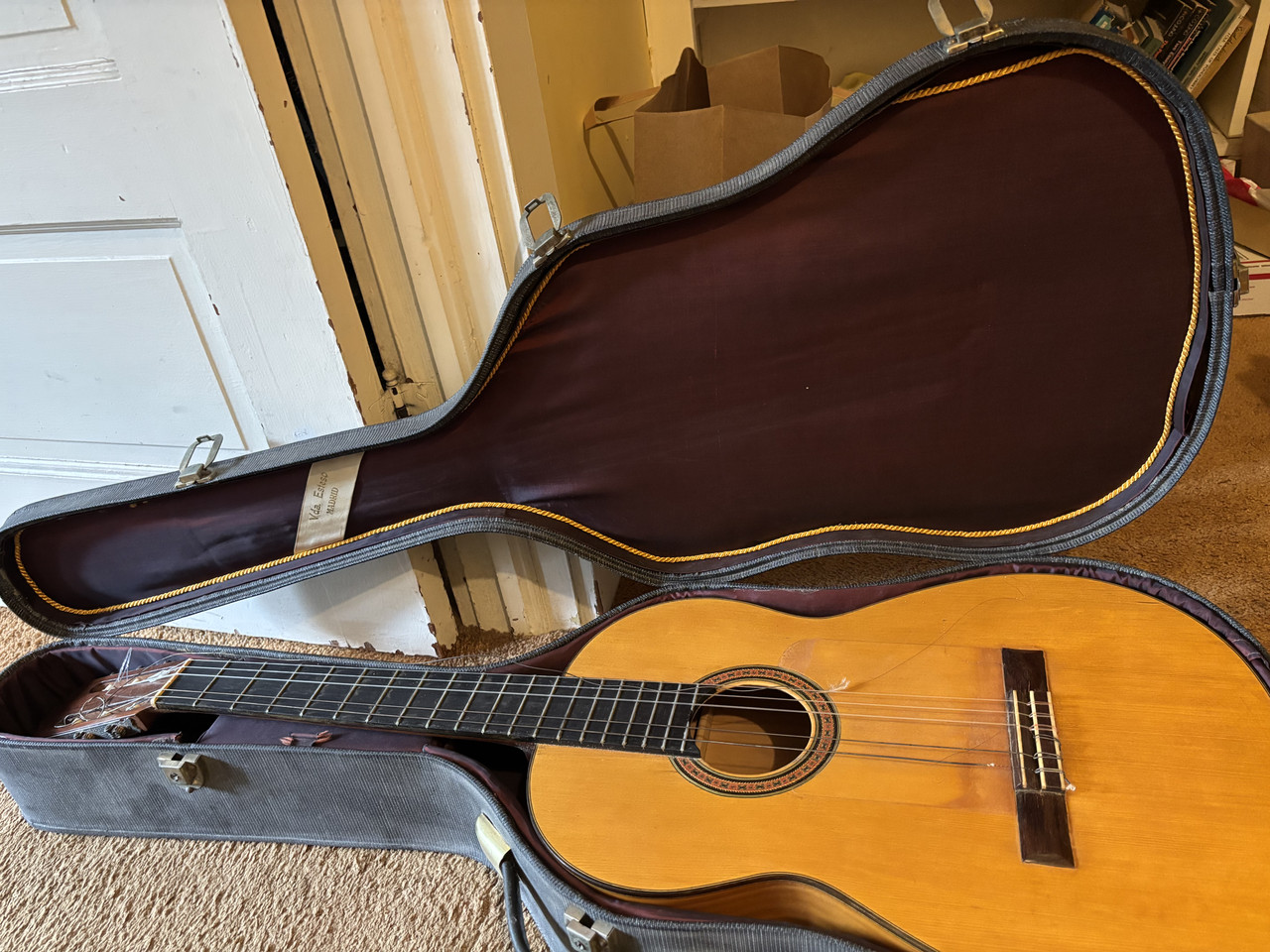
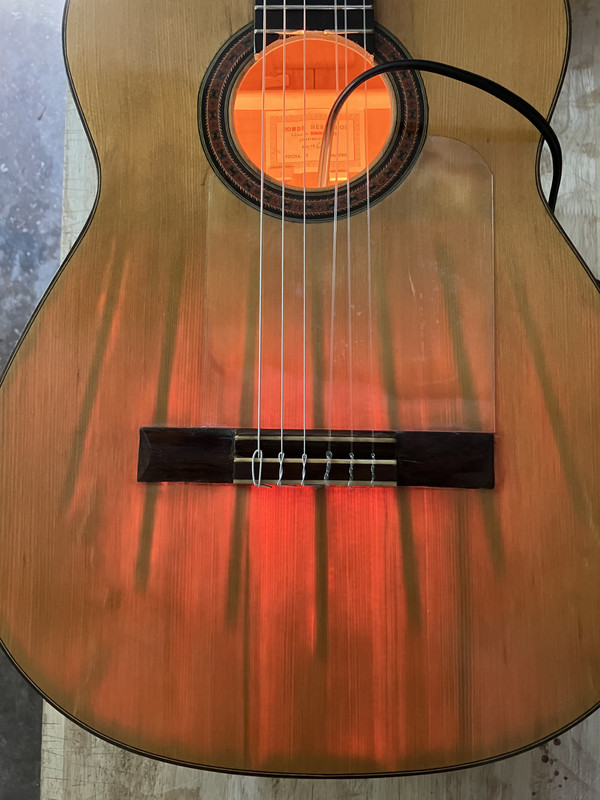
Unisgned Sobrinos de Esteso with a couple of back cracks but should be pretty sweet! Still needs one crack repaired and a new golpeador (old one peeled off almost instantly). Can't wait to hear it.
Images are resized automatically to a maximum width of 800px
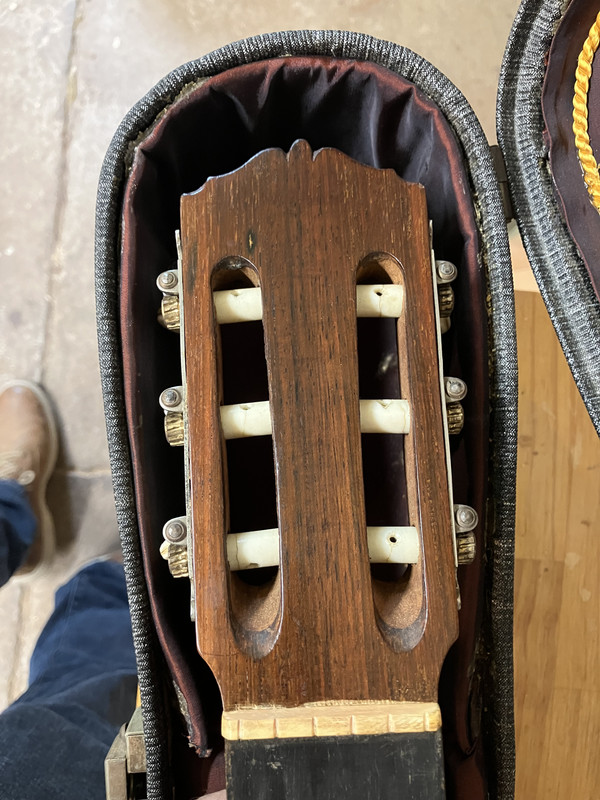
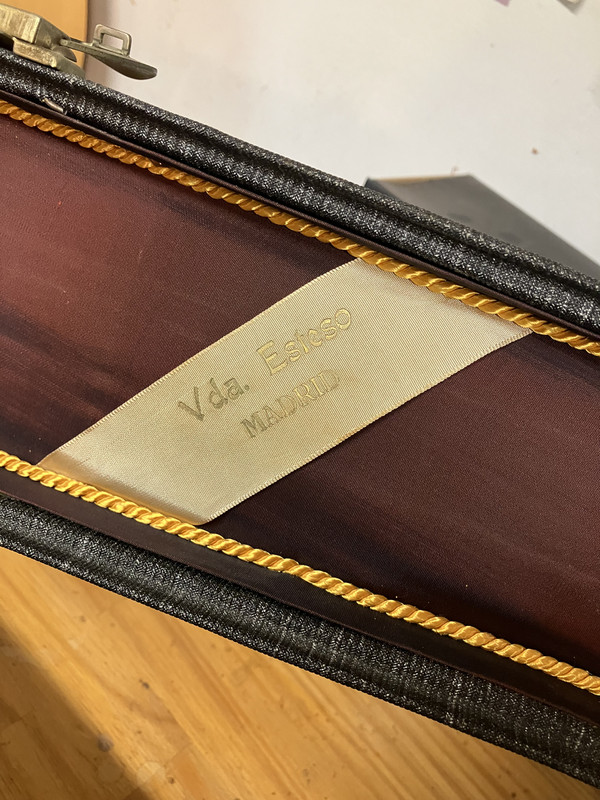
I am into that Viuda de esteso case more than the guitar.
The case is super cool! Not even too beat up. My friend who sold it to me said it was his Dad's (recently passed) and he never heard or saw him play it. So it definitely has some waking up to do after 40+ years.
It took me a minute but I'm starting to really like this guitar. It felt kind of stiff at first, but I realized it's one of those guitars that really demands and rewards a strong right hand. When I push it hard it totally outclasses my guitar. It feels like a professional's guitar but I'm not sure I'm up to the challenge!
Exactly. These guitars have that and also that macho tone on the fundamentals which makes them very loud in a noisy environment if pushed. Somehow the thing about “pulsación” (which is now meant as a joke here in the forum) makes perfectly sense when you associate that with these kind of guitars. Your guitar is made substantially the same as a first class Esteso of those years: The Conde made in later years are 200 grams heavier and mellower but still keep that quality.
Yep this is 100% a "masculine" guitar. If pulsación is a myth then I guess I believe in bigfoot. You can tell from the first notes that it has a stiffer right hand feel.
For those who are curious: It has a slightly asymmetric bracing where the braces on the treble side are angled slightly more than the ones on the bass side. Similar to certain Santos Hernandez ideas from the mid-'30s
The top is relatively thick, mostly about 2.4-2.5 mm measured with a Hacklinger gauge, with some thinner areas on the bass side. But the fan braces are very low, 3 mm tall at most with a pyramid shape. Body resonance F#. Total weight 1333 grams. 650/52. After playing for a while I believe it is a serious instrument! It sounds much more open today than it did yesterday.
Images are resized automatically to a maximum width of 800px
Setup is 7.5 mm at the bridge and 3 mm action all the way across. A little high but it helps the notes ring out and it seems intentional as the neck is dead flat and the soundboard doesn't show any deformation.
Intonation is...honestly...spot on. Perfect saddle compensation. The action right now is right at 3mm so it's higher than I'm used to. But, I'm getting used to it and it's actually really nice to be able to play clean.
I'll make a better video at some point because I was trying to play in the traditional position for some reason and struggling. It's a guitar unlike anything I've ever played which is the main reason I decided to keep it (also I really like the rosette).
This is the least "pretty" sounding guitar I have ever played. You do not want to play classical on this thing. But the sound somehow transports you perfectly to another time and place, and is so bold and assertive. It's awesome.
Nice. In terms of "compensation", well, my 1973 sobrinos is 670 mm scale and the 12th is smack in the middle, 0.0 compensation. Local luthier (impressed this was measuring in inches not mm) was like "doesn't this thing play sharp up high??", and I explained how my dad's Hauser 2, the bridge is like 3.x mm pulled back and I must pull back toward the nut when playing up high to compensate for the compensation.
Pulsation bias= "3mm yet it is a bit high for me". But I will let people keep their beliefs because they shape the subjective reality experience. My main point all along is the definition of the word in English is "action". Lower it and achieve "soft pulsation" rather than "stiff pulsation".
im intrieged by the offset treble bracing but moreso by the amount of unsuported top plate aft of the bridge or rather aft of where the sound bars end combined with the thicker top. Wonder how much this had to do with the guitars particular charictor?
i have two WRC tops mid rosette and giving me food for thought in how i plan to brace them… both will be long scale flamencas.
So…, how many of you reached out to Andy right away interested in aquiring this Conde even before he started gushing over her? Raises hand.
HR
_____________________________
I prefer my flamenco guitar spicy, doesn't have to be fast, should have some meat on the bones, can be raw or well done, as long as it doesn't sound like it's turning green on an elevator floor.
ORIGINAL: Andy Culpepper Oh, I found a new definition of pulsation 2:55
According to Merriam-Webster, he is using the English word "pulsation" correctly: a brief vibration.
But maybe he thinks he's using the Spanish word "pulsación." According to the Diccionario of the Real Academia Española it means "Acción de pulsar."
For "pulsar" the Academia gives "Tocar, palpar, percibir algo con la mano o con la yema de los dedos". "To touch, sense by touching, or perceive something with the hand, or the tips of the fingers," which is precisely what Spanish people mean when talking about guitars.
But maybe he thinks he's using the Spanish word "pulsación." According to the Diccionario of the Real Academia Española it means "Acción de pulsar."
For "pulsar" the Academia gives "Tocar, palpar, percibir algo con la mano o con la yema de los dedos". "To touch, sense by touching, or perceive something with the hand, or the tips of the fingers," which is precisely what Spanish people mean when talking about guitars.
Notice it never says anything about the "stiffness of a guitar soundboard or its bracing concept". "playing action as per the touch sensitivity of the FINGERS". That means STRINGS AND FINGERS. Now, WHICH FINGERS???? It was once the "touch sensitivity of the RIGHT HAND RASGUADO ETC" and the magical leprechaun transference of that feeling via the SOUNDBOARD and build design getting into the STRINGS somehow. Where as "touch sensitivity of the LEFT HAND" is a crystal clear thing:HEIGHT OF STRINGS OVER THE FINGERBOARD. And Amalia Ramirez and Ricardo say there is no magic Leprechaun, the RIGHT HAND is feeling the response of the HEIGHT OF THE STRINGS OVER THE FINGERBOARD, as well. The confusion arose historically from noticing two DIFFERENT guitars that measure the same at the 12th fret feel different, yet don't account for the neck angle achieving that measurement.
This ("right hand feel") is what prompted my dictionary excursions:
quote:
ORIGINAL: Andy Culpepper
Yep this is 100% a "masculine" guitar. If pulsación is a myth then I guess I believe in bigfoot. You can tell from the first notes that it has a stiffer right hand feel.
For those who are curious: It has a slightly asymmetric bracing where the braces on the treble side are angled slightly more than the ones on the bass side. Similar to certain Santos Hernandez ideas from the mid-'30s
The top is relatively thick, mostly about 2.4-2.5 mm measured with a Hacklinger gauge, with some thinner areas on the bass side. But the fan braces are very low, 3 mm tall at most with a pyramid shape. Body resonance F#. Total weight 1333 grams. 650/52. After playing for a while I believe it is a serious instrument! It sounds much more open today than it did yesterday.
Andy has built at least 179 guitars. I remember Amalia Ramirez saying she had built one, under her father's supervision. Amalia may have seen or heard more guitars than Andy, and probably has sold more. I have no idea of Amalia's skill as a player (if any), Andy plays pretty well. But Andy has no doubt had far more personal experience than Amalia with the effect of construction details on guitar right hand sensation.
I don't have very many guitars, but I do have three with the same action at the 12th fret, the same height above the soundboard at the bridge, and the same strings. Each feels different to my right hand.
"Action" and neck angle are objective measurements. "Pulsación" is a sensation, with a subjective element. Yet experienced guitar people talk and write as though they expect others to have a sensation similar to their own.
I think some of the discussion is due to the apparent similarity of two words which have very different meanings in their respective languages.
The topic has been discussed to death but...my personal opinion is that it's all about the responsiveness of the guitar. I don't think on a guitar that feels stiffer to the right hand that the strings are ACTUALLY stiffer, as in measurably higher tension or something, that would be easily disproved. I think it's in that aspect of feeling like it needs a heavier hand to get it moving or to elicit the desired response from the guitar. You have to adjust your attack to get the sound you want and it results in feeling like you're working harder.
I don't think that seems particularly far-fetched or controversial, but here's where I get slightly more out there: I think the guitar back plays a role in pulsacion. I had an experience when building my first guitar where I had it strung up in the white and was playing while making various adjustments, and after scraping the back to a certain point, all of a sudden the pulsacion seemed to change and got looser. Another time I had an unusually porous set of Panama Rosewood and the guitar played like a dream until after I filled all those giant pores, then it kind of seized up and ended up being a rather stiff feeling instrument.
If you accept my first point though it follows somewhat logically that both the top and the back could have an effect, since they both can affect the resonance and tonal response of the guitar. Especially important I think is the relationship between the two and the overlapping resonant modes.
I don't disagree that there are small factors that compound and add to the final results of what we experience subjectively. Maybe AI will "crack pulsación" like it cracked Navier stokes chaos blowup.
Meanwhile, we can objectively fix the stiff or soft pulsación via lowering or raising the saddle, that is my main point. It is the giant variable in the equation.

 Printable Version










 New Messages
 No New Messages
 Hot Topic w/ New Messages
 Hot Topic w/o New Messages
 Locked w/ New Messages
 Locked w/o New Messages
 Post New Thread