Welcome to one of the most active flamenco sites on the Internet. Guests can read most posts but if you want to participate click here to register.
This site is dedicated to the memory of Paco de Lucía, Ron Mitchell, Guy Williams, Linda Elvira, Philip John Lee, Craig Eros, Ben Woods, David Serva, Tom Blackshear and Sean O'Brien who went ahead of us.
We receive 12,200 visitors a month from 200 countries and 1.7 million page impressions a year. To advertise on this site please contact us.
ORIGINAL: El Burdo Intuitively I can't help but think the bridge and saddle must have something to do with the sound, and maybe the feel. It's one of only two limits (ends) on the body where the strings directly impact the response of the top. But evidently not considered as being important.
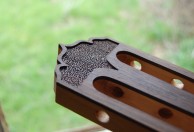
The total mass of the bridge and saddle combination has effects. The stiffness of especially the wings has effects. The material of the saddle may have effects but it's hard to separate that from changes in mass.
String height at the bridge changes the leverage of the strings on the top. This definitely has effects on the balance of partials in the sound, and, counterintuitively, basically no audible change in sustain or attack, at least according to Alan Carruth's experiments, which occasionally come up here.
String leverage does have another interesting effect though, which is that it is a major factor in how stiff the soundboard needs to be to resist the rotational force on the bridge. Lower the leverage and you can have a more lightly built soundboard.
Another interesting factor is the way forces at the bridge change the static stress state of the top. I can't speak to how much of an effect this has in the small typical range of saddle adjustments, but it may parallel one possible mechanism by which increased string tension can awaken or stifle a given guitar.
Thanks Fawkes. I'll have a look at Carruth's work if I can find it. There was an old timey (with respect) maker on here a while ago who raised some exciting intentions to measure top responses but he disappeared after saying hi. Probably, no-one said hi back. I can't use Search any longer with any accuracy to find him. Not being particularly technically minded, I have come to see an instrument as responding to the actions of many butterflies flapping continents away and it's curious to see that significant measurable effects don't have predictable real-world effects. To me the tightly focussed vibration transmission of the saddle to the bridge and hence the top is undiscovered territory. Yet we still choose the same setup. I expect Michael Kasha had a look and decided it wasn't worth it.
You cannot really do too much with it. Let me elaborate: I believe that to add or remove mass at the bridge, as well as in certain nodal points of the top, works in fixing conflicting harmonics and to release the full potential of the guitar . Yet, it’s extremely difficult to get to alter the leverage etc. I recently replaced a guitar bridge on a light flamenco guitar ( I’ve done this job many times btw) : at the beginning the bridge was overbuilt enough to get a series of unwanted effects, like sustain etc. I had to gradually shave the wings down to adjust it till I got the right result. The feeling on the right hand or the way it sounded didn’t changed too much though out the process..
The topic has been discussed to death but...my personal opinion is that it's all about the responsiveness of the guitar.
my apologies this thread has gone off the rails it seems with this topic. I think confirmation bias is the main issue that is affecting the definitions of this topic. If you play a certain way, harder or softer by your subjective experience of the sound coming out, you will automatically assume the pulsacion is causing this, and then the variables that change you then believe are the "cause". Like you get a brighter response and feel working less the guitar is softer when all that happened was the frequency response. Same if the guitar is too humid and dries out or vice versa. Then you have people wrongly believing that the guitar is built inherently with these characteristics and a new bias is established "I need a stiff pulsacion like this old Conde", and etc. My personal experience of guitar response got orders of magnitude less complicated when I recognized the statement by Amalia Ramirez that we can change this with the action adjustment at the saddle. Bingo, but perhaps it is my own confirmation bias but erasing that problem makes the situation very clear and easy to address.
my apologies this thread has gone off the rails it seems with this topic. I think confirmation bias is the main issue that is affecting the definitions of this topic. If you play a certain way, harder or softer by your subjective experience of the sound coming out, you will automatically assume the pulsacion is causing this, and then the variables that change you then believe are the "cause". Like you get a brighter response and feel working less the guitar is softer when all that happened was the frequency response. Same if the guitar is too humid and dries out or vice versa. Then you have people wrongly believing that the guitar is built inherently with these characteristics and a new bias is established "I need a stiff pulsacion like this old Conde", and etc. My personal experience of guitar response got orders of magnitude less complicated when I recognized the statement by Amalia Ramirez that we can change this with the action adjustment at the saddle. Bingo, but perhaps it is my own confirmation bias but erasing that problem makes the situation very clear and easy to address.
I don't think the "pulsacion" is *causing* the guitar to feel like it needs to be played harder or softer, I think that feeling of needing to be played harder or softer just *is the definition* of pulsacion.
I'll be the first to admit that I'm not the best player in the world but I definitely encounter certain guitars that just are physically more demanding to play for the right hand. Like these guitars will even chip the krazy glue off my nails faster than most. The guitar may even feel and respond like I'm playing close to the bridge when I'm actually half way toward the soundhole. It's actually somewhat rare to encounter guitars like that, I would say like 90% of the guitars I try just feel "normal" but there are certain outliers.
Now I will say that setup DEFINITELY plays a role in this, it's possible it may even be the biggest factor. A guitar with a higher action will tolerate and require more force to produce the raspy, hard-driven sound that most of us look for when we play flamenco. The string height at the bridge I think is less of a factor for this particular phenomenon, my guitar is fairly low there (7.5mm) but still has that stiffer feel. But of course that matters for certain things like golpes and such.
To summaraize, I think that pulsacion = the perceived right hand effort required to elicit the desired tone or response from the guitar.
This can be influenced by factors like action, but also certain elements of how the guitar is contructed such as: -soundboard construction -bridge design and weight -relationship of top and back frequencies -internal damping/speed of sound in the woods used (yes you can use a device called a Lucchi meter to measure the speed of sound in a piece of wood and it can vary a lot between pieces or even different areas of the same piece) etc.
Just one man's opinion, take it with a grain of salt on the fingers!

 Printable Version


 New Messages
 No New Messages
 Hot Topic w/ New Messages
 Hot Topic w/o New Messages
 Locked w/ New Messages
 Locked w/o New Messages
 Post New Thread