Welcome to one of the most active flamenco sites on the Internet. Guests can read most posts but if you want to participate click here to register.
This site is dedicated to the memory of Paco de Lucía, Ron Mitchell, Guy Williams, Linda Elvira, Philip John Lee, Craig Eros, Ben Woods, David Serva, Tom Blackshear and Sean O'Brien who went ahead of us.
We receive 12,200 visitors a month from 200 countries and 1.7 million page impressions a year. To advertise on this site please contact us.
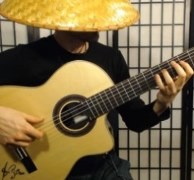
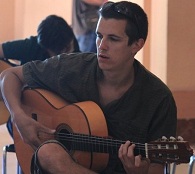
What guitar are you playing, I couldn't make out the label.
It was made by my friend Max Bishop, who passed away last year. This was the second of two he made for me. I exchanged the first one as the bridge set up was too high (neck angle was too classical for my tastes).
I am learning a piece called Mantillas de Feria by Estaban de Sanlucar and arr. by Juan Serrano.
The 6th string is tuned down to D and the 5th string down to G.
I'm looking for other flamenco pieces with this tuning so I don't retune for just one piece.
Any help is appreciated.
If you are looking for things closer in style (and perhaps technical level), Manuel Cano did a lot of things (inc. Zambras, Tientos, Siguiriyas/Serranas, Bulerías, Fandangos etc.) in drop D, Rondeña tuning (drop D and 3rd to F#), drop D and G, and even an Alegrías/Caracoles (Madrid Flamenco) in drop C and G.
you can use the search box top left if you want to find other the recordings and transcriptions from him in the other tunings, as well as standard tuning stuff.
It is inspired by this arrangement probably by Tarrega or someone:
I didn't know Esteban de Sanlucar was inspired to create Mantilla de Feria by Tárrega's transcription for guitar of Sevilla by Albeniz - is that documented somewhere?
It is inspired by this arrangement probably by Tarrega or someone:
I didn't know Esteban de Sanlucar was inspired to create Mantilla de Feria by Tárrega's transcription for guitar of Sevilla by Albeniz - is that documented somewhere?
"probably" is the key word, however, the piece is very famous in the classical guitar world and the nature of the compositions by Esteban (and later Riqueni) makes it obvious to someone like me that they would not have invented that by accident. In particular the modal modulations that occur in Sevilla by Albeniz (G major to G Phrygian and back) are mimicked as well. But who knows, maybe Cano was the inspiration? Or more likely the Sabicas piece mentioned.
"probably" is the key word, however, the piece is very famous in the classical guitar world and the nature of the compositions by Esteban (and later Riqueni) makes it obvious to someone like me that they would not have invented that by accident. In particular the modal modulations that occur in Sevilla by Albeniz (G major to G Phrygian and back) are mimicked as well. But who knows, maybe Cano was the inspiration?
I took the "probably" to refer to the probable transcriber i.e. Tárrega, rather than that Esteban de Sanlúcar probably took the idea of the tuning and possibilities from guitar versions of the Albeniz piece which, point taken, no doubt he did.
There seems to have been some dialogue, or at least encounters, between classical and flamenco guitar in the early 20th Century (Miguel Borrull apparently accompanied cante professionally but played pieces by Tárrega "in private", Ramon Montoya knew, or at least met, Miguel Llobet in Madrid, and classical composers like Albeniz created their romantic fantasy "impressions" inspired by folklore and flamenco etc.), so no doubt the Sevilla transcription and tuning were known.
Also, a transcription by Tárrega of the Albeniz piece "Cádiz" has apparently turned up (in a manuscript copied out by Llobet) in drop D and G tuning (I think more often transcribed in A major in standard tuning or D major in drop D tuning).
Don't know when Esteban de Sanlúcar composed Mantilla de Feria, but he was born 15 years before Manuel Cano, and Cano's recordings start from 1958.[https://www.discogs.com/artist/905365-Manuel-Cano]
I think by then Esteban de Sanlúcar was living in Argentina.
There is also a book of Manuel Cano transcriptions. Tunings are standard, drop D and Rondeña, nothing in drop D and G, but it does come with 2 CD's, one of tracks from his LP's, and another with some live concert solos and some tracks of Cano accompanying cante.
Tomatito has Colombiana but I can't recall the exact tuning there.
I checked the Faucher article on altered tunings, remembering there was something about this, but couldn't remember what. The Affedis website seems to only show the part 1, but there were originally 4 parts.
This is from part 3:
Tomatito, again, with Armonias del Romañe (colombiana from the record Barrio Negro) creates an arrangement of the G tuning that goes, from bass to treble: D, G, B, G, B, E. It differs from the former G tuning in that the fourth string is B instead of D. This permits a C-Major chord (the IV chord in the G-Major tonality) to be made with a simple bar at the fifth fret over the six strings, which was impossible before.
In case you missed some of my posts about it months ago, the Rondeña of Montoya was not only instrumental influenced, he first accompanied Taranta using the tuning, and Faustino Nuñez found an eyewitness in 1800 record that some guitarists would drop the third string to F# to play a certain "polo" in that minor scale (gives our Rondeña tonality), then back to normal for other pieces...suggesting Montoya had either rediscovered an old practice or preserved it for posterity (hard for me to believe the singer would have accepted that weird experimental sound unless it was vaguely familiar in the tradition already).
And even John Griffiths (vihuela expert) thanked me for pointing out the fact the flemish mass of Josquin des prez tabbed out by Pisador in 1552(!) required the drop D Rondeña tuning (tonic C# Phrygian or "la sol fa re mi" Phrygian catholic mass). That plus the 6 pieces that are used by Fuenllana in that tuning suggest an old practice in spain of using that tuning/tonality for "flemish motets" more generally, aka certain flamenco palos. Our lexicon still employs "vihuela speak" like "Tientos", "Romances", "Tonos", "compás", "redobles", solmization syllables (re mi fa sol etc.)
Or it is all just coincidence, so take your pick. It is at least instructive.
 Printable Version




 New Messages
 No New Messages
 Hot Topic w/ New Messages
 Hot Topic w/o New Messages
 Locked w/ New Messages
 Locked w/o New Messages
 Post New Thread