Welcome to one of the most active flamenco sites on the Internet. Guests can read most posts but if you want to participate click here to register.
This site is dedicated to the memory of Paco de Lucía, Ron Mitchell, Guy Williams, Linda Elvira, Philip John Lee, Craig Eros, Ben Woods, David Serva, Tom Blackshear and Sean O'Brien who went ahead of us.
We receive 12,200 visitors a month from 200 countries and 1.7 million page impressions a year. To advertise on this site please contact us.
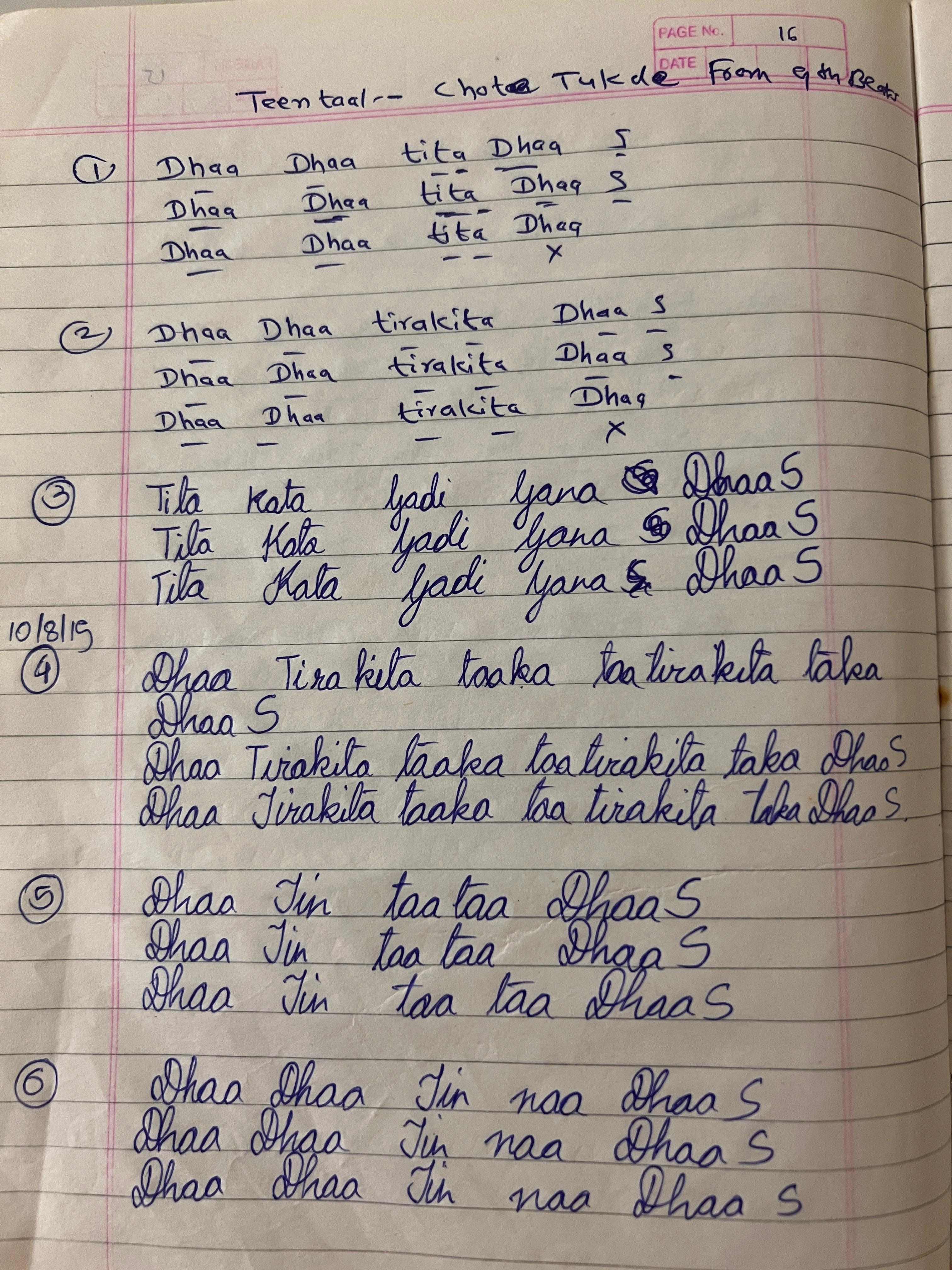
Today I stumbled upon this tabla notebook from 11 years ago, back when I was 12 and used to learn tabla. When I looked at these weird phrases today, they instantly made sense to me.
Each of these syllables is played using different fingers and different parts of the tabla. For example, dhin, from what I can vaguely recall, was played on the larger of the two drums (for the unfamiliar, tabla has 2 drums: one small and one big) using the middle and ring fingers simultaneously, kind of exactly like how we play golpes. Except the former was done using the left hand.
It later occurred to me that I never played with a metronome or even knew what one was back then. You would imagine that a percussion instrument has to be practiced with a metronome. I didn't know much about rhythm and timing. But when I think back to my playing from that time, I remember playing decently and with good rhythm.
When I was learning tabla, our teacher would write these down, sing them for us, and make us rote-memorize these phrases until we could also sing them naturally. Only then would he teach us how to implement them on the tabla. Then he would make us sing and play on the tabla simultaneosly.
I realized the trick lies in the syllables themselves and probably why our teacher didn't introduce us a metronome. These syllables are quite fascinating. If you can memorize & sing them properly and fluently, you don’t really need a metronome. After all, how did people in older times develop rhythm when there was no metronome?
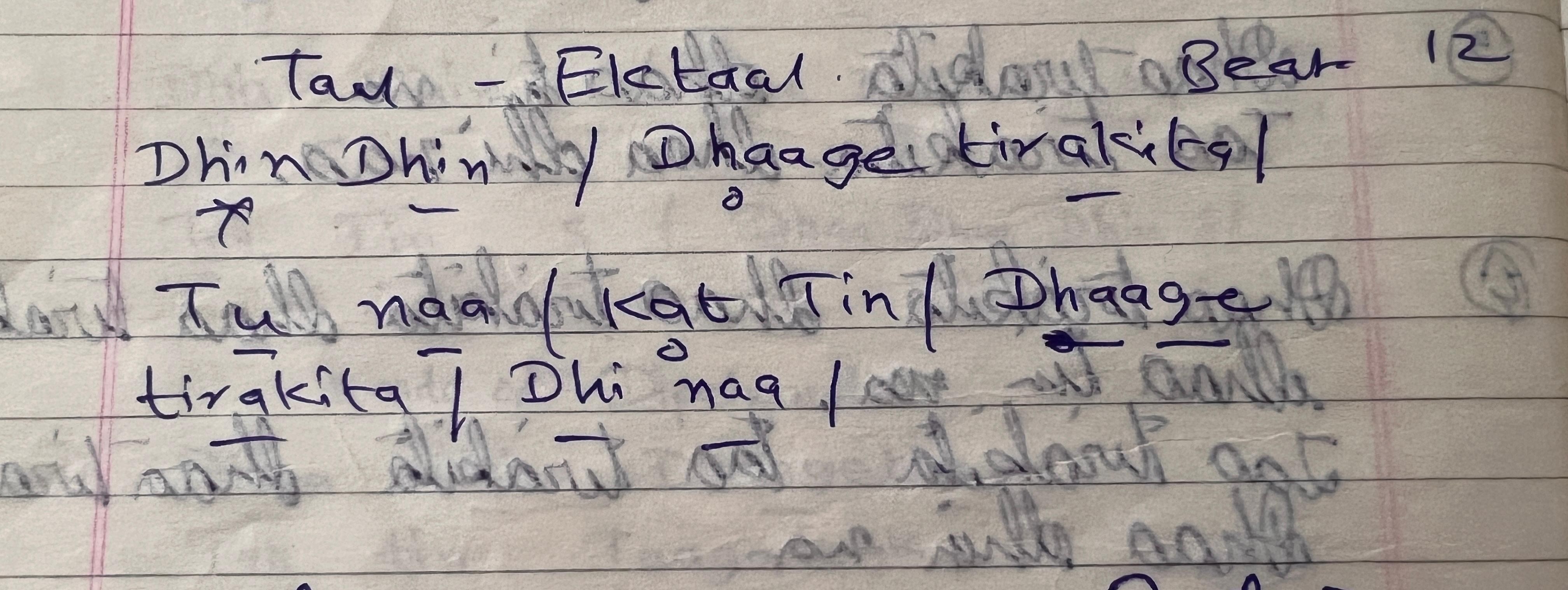
Take the second screenshot, for example; Ektaal - 12 beats, but once you memorize it, it becomes easy:
“Dhin dhin | Dha-ge ti-ra-ki-ta | Tu naa | Kat tin | Dha-ge ti-ra-ki-ta | Dhi naa”
If you had to rephrase it in western beats: 12 1 | 2& 3e&a | 4 5 | 6 7 | 8& 9e&a | 10 11 and sing it, it becomes easily challenging at faster tempos. Add to it playing an instrument simultaneously, it becomes even more daunting.
The first one, however, is easy to speak fluently at even faster tempos. And the crazy thing is, the first one does not need a metronome to space out the beats evenly. The syllables themselves do that trick.
To an American tongue, the first might take a while.
No question for today, just wanted to share this!
Images are resized automatically to a maximum width of 800px
RE: Metronome vs vocal clock (in reply to metalhead)
Flamencos have their own way of counting the beats. Ta-ka 8th notes Ta-ka-Ta-ka 16th notes Ta-ka-ta one triplet Ta-ka-ta-Ta-ka-ta two triplets
You see there are only 2 syllables ta ka which are not difficult to vocalise at faster tempos. tktktktk 150 bpm or higher. tkatkatka 100-150 bpm takataka 100 bpm or lower
quote:
If you had to rephrase it in western beats: 12 1 | 2& 3e&a | 4 5 | 6 7 | 8& 9e&a | 10 11
|ta ka | taka takataka | ta ka | ta ka | taka takataka | ta ka
RE: Metronome vs vocal clock (in reply to devilhand)
I think you haven't quite understood my post correctly. counting picado with a generic "tktktk" isn't remotely similar. And I don't think Paco was even meaning to count the picado with "tktktk". I think he was just setting a tempo for his playing.
RE: Metronome vs vocal clock (in reply to metalhead)
quote:
Take the second screenshot, for example; Ektaal - 12 beats, but once you memorize it, it becomes easy:
“Dhin dhin | Dha-ge ti-ra-ki-ta | Tu naa | Kat tin | Dha-ge ti-ra-ki-ta | Dhi naa”
If you had to rephrase it in western beats: 12 1 | 2& 3e&a | 4 5 | 6 7 | 8& 9e&a | 10 11
From this example, why do they use different syllables to indicate the same rhythmic bit? (dhin, tu, naa, kat, tin all seem the same length)
ALso, in terms of intuition, I can understand how "Dhin Dhin" could imply the longer durations when compared to dha-ge because the tongue takes a moment to adjust pronouncing the two consonants after one another - the "n" of the first syllable and the "d" of the second. But that is not true for "tu naa" which is very easy to pronounce as fast as the faster sequences, yet is interpreted as the same durations. Why? Is it all historical, so not necessarily very systematic and self-consistent?
RE: Metronome vs vocal clock (in reply to kitarist)
1. Each of the syllables are used to denote different ways of getting sound from a tabla. If all the phrases were same, how would players know what to play?
2. Dhage requires 2 vocal impulses to say out loud: dha & ge. These extra syllables help vocalize a subdivision of the beat.
dhin dhin & tu naa are interpreted as having the same duration due to how they are pronounced. All 4 are single syllables i.e requiring just one vocal impulse.
It's the same reason why you give beats 'two' and 'nine' in a bulerias the same rhythmic duration even though 'nine' appears to take longer to say.
RE: Metronome vs vocal clock (in reply to metalhead)
quote:
ORIGINAL: metalhead
1. Each of the syllables are used to denote different ways of getting sound from a tabla. If all the phrases were same, how would players know what to play?
How would I know? - I was asking because of not knowing much about the practice and notation. From your answer I now understand that a syllable is not just indicating rhythmic length but also type of sound; that explains why different syllables for the same duration are used.
quote:
2. Dhage requires 2 vocal impulses to say out loud: dha & ge. These extra syllables help vocalize a subdivision of the beat.
dhin dhin & tu naa are interpreted as having the same duration due to how they are pronounced. All 4 are single syllables i.e requiring just one vocal impulse.
OK, from this I understand that a single 'word' of one or more syllables implies the base duration (no subdivisions), and that things like dha-ge are not two one-syllable words one after another, but meant to indicate one single word 'dhage' with two syllables - thus have to fit in the space of the base duration, implying subdivision by 2. Analogously, ti-ra-ki-ta is meant to be seen as one 'word' of four syllables, and that one word 'tirakita' has to fit within the base duration , thus dividing by 4. And one-syllable words have just one tap for that duration.
Basically, single words = same base duration, and number of syllables indicates how many equally-divided taps one makes within that time. Interesting.
I remember 20 years ago I convinced a drummer to learn tabla, and a flute player to play bansuri , we were young , just to play Shakti pieces and our own music.
Posts: 16435
Joined: Dec. 14 2004
From: Washington DC
RE: Metronome vs vocal clock (in reply to metalhead)
quote:
I realized the trick lies in the syllables themselves and probably why our teacher didn't introduce us a metronome. These syllables are quite fascinating. If you can memorize & sing them properly and fluently, you don’t really need a metronome. After all, how did people in older times develop rhythm when there was no metronome?
The metronome is for maintaining solid tempo, not teaching subdivisions. All drum systems that have some sort of teaching discipline use vocalizations (syllables) of different sorts to quickly grasp challenging phrases, but the issue here is tempo is separate from that. No one should be excusing practice without a metronome no matter how advanced. Only improvement of control results. Practice without results in falling into trends of dragging or rushing the time unconsciously. When two different people speak the same sentence they do not necessarily execute the syllables at the same speed.
Posts: 16435
Joined: Dec. 14 2004
From: Washington DC
RE: Metronome vs vocal clock (in reply to devilhand)
quote:
ORIGINAL: devilhand
quote:
The metronome is for maintaining solid tempo, not teaching subdivisions.
Traditionally yes. Nowadays they do use it for subdivisions as well.
No. Subdivisions are a separate issue from tempo. Yes you want to learn them as evenly executed of course. I don't consider the "potty trainer" metronomes that provided subdivisions separate (like clicks that accent in groups) as "metronomes" as much as "drum machines". Anything more than a simple un accented click is a "rhythm machine" of some sort IMO.
The main point of my sentence was that once subdivisions are internalized via vocalization, that the metronome is rendered unnecessary according to the OP, which is not true.
regardless if you use a click or a potty training rhythm machine, tempo is separate from subdivision.
RE: Metronome vs vocal clock (in reply to Ricardo)
Ok. Let me put it differently. Metronome is a great device for those who want to improve their timing. How about playing behind, or ahead of a metronome click?
For example you can set a metronome click on the third beat of a 8th note triplet. You play 2 beats ahead of that click. By doing so you and your metronome create shuffle rhythm. You can do similar stuff with a 16th note subdivision at different bpm. Metronome click on the 1st and 3rd beat. You play the 2nd and 4th beat, or only the 4th beat.
Posts: 16435
Joined: Dec. 14 2004
From: Washington DC
RE: Metronome vs vocal clock (in reply to devilhand)
quote:
ORIGINAL: devilhand
Ok. Let me put it differently. Metronome is a great device for those who want to improve their timing. How about playing behind, or ahead of a metronome click?
For example you can set a metronome click on the third beat of a 8th note triplet. You play 2 beats ahead of that click. By doing so you and your metronome create shuffle rhythm. You can do similar stuff with a 16th note subdivision at different bpm. Metronome click on the 1st and 3rd beat. You play the 2nd and 4th beat, or only the 4th beat.
yes of course that is how the advanced player will use the click. I simply say treat it like a person that is following YOUR rhythm, and how they seem to follow you is based on your personal control of the subdivisions.
But that is very advanced...let us first get people on board with keeping a freaking beat as in play smack in the center of the darn click perfectly and consistently FIRST. That is the thing unfortunately MANY people think they can do and can NOT.
I already told the story but I work with a TOP level flamenco percussionist, maybe the best in the USA (that I have ever worked with), he is dead accurate most of the time. One day we were on the gig and he was tired or whatever, I felt the drag every song. The very last song of the set we did a fast rumba with the drum machine and he was still "dragging" or rather his playing felt like the machine was slower than it was. I let it continue until the FINAL chorus and then with the guitar I moved the feel to "on top" of the beat (remember nothing about the machine changed) and kept that up till the end. He started cracking up laughing then asked "bro I was dragging wasn't I?", I was like "yes the entire set".
For high level pros it is fun, a game but it can be extremely frustrating when we work with people that think they are just fine and really need to work on these details. Like this was just one off day but there are people that play like that all the time and think they are awesome. In my experience anyway.

 Printable Version




 really cool.
 New Messages
 No New Messages
 Hot Topic w/ New Messages
 Hot Topic w/o New Messages
 Locked w/ New Messages
 Locked w/o New Messages
 Post New Thread