Compas explanation (Full Version)

Foro Flamenco: http://www.foroflamenco.com/
- Discussions: http://www.foroflamenco.com/default.asp?catApp=0
- - General: http://www.foroflamenco.com/in_forum.asp?forumid=13
- - - Compas explanation: http://www.foroflamenco.com/fb.asp?m=72390


Message


Bogdan1980 -> Compas explanation (Aug. 26 2007 20:32:43)

So guys, I've been fighting with this for a while now. Can we all get into this an try to lay it out in the simplest terms!? I read that flamenco compas is complex, and I have this large document with compas analysis, but it's very unclear (I think I got it from this forum). I seem to be good with staying in the rhythm, so I learnt Barrio La Vina (alegrias), and it seems to sound right, but I don't really have an understanding of what's going on,.

How can I figure out the compas? Especially things like Bulerias and Soleares. I know it's a 12 count, and it goes something like 1-2-3 --1-2-3 --1-2- -1-2-- 1-2

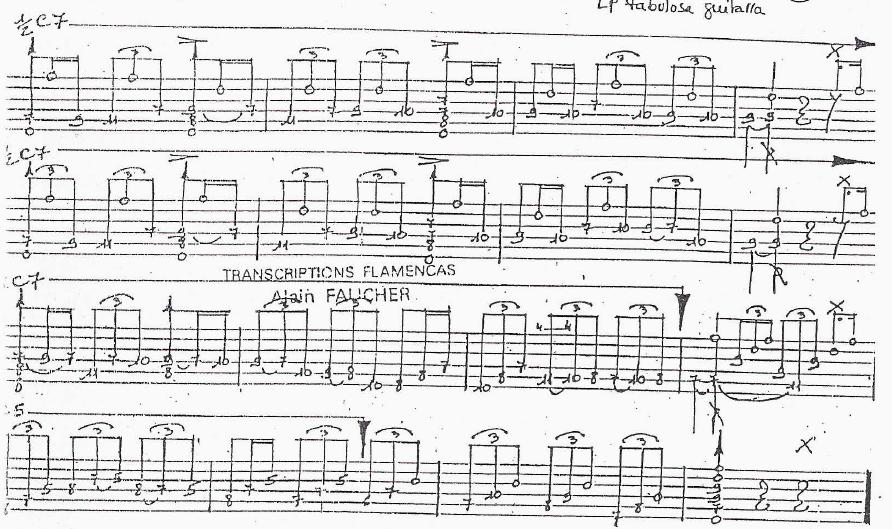
But how do you apply this? Attached here is the image of PDL Solea, (beginning), how would you count through this?


Images are resized automatically to a maximum width of 800px


Stu -> RE: Compas explanation (Aug. 26 2007 21:23:11)

Hey, I'm not sure how much you do or dont know, so if I patronise, sorry.

Now from what I'm looking at, each line of that music is worth 12 beats.
The 12 beats are split up by the vertical bar lines across the tab/string lines.
Within each of those bars is 3 beats. every thing here is in triplets which means the groups of 3 notes tied together with the lines are worth one beat.

That aside, if you are unclear on soleares compas you should probably practise an easier piece before any paco stuff.

Stu


Ricardo -> RE: Compas explanation (Aug. 27 2007 3:52:34)

quote:

I seem to be good with staying in the rhythm, so I learnt Barrio La Vina (alegrias), and it seems to sound right, but I don't really have an understanding of what's going on,.


You seem to???? Then what is the problem? Sorry to also sound patronizing, but you have "learn't" Barrio la Viña but are not sure what is going on with the compas.

Trying to learn from the top down is the hard way. First you need to have a base of rhythm guitar, that being rasgueados. Once you can do that in compas, you start with some basic traditional type phrased falsetas, stuff like guitar accompanists use to accompany footwork. Once you have THAT then, these Paco FALSETAS (not the entire piece as if it is a sonata allegro) will be crystal clear interms of rhythmic phrasing.

I have a student that also learned RECUERDO A PATIÑO from Fabulosa. In anycase, he also knew nothing about the compas before his first lesson and even though he could make it sound sort of right, it was ALL WRONG because he did not feel the phrasing. So he learned quick the basics I described and then went back and applied what he learned to this piece and relearned SOME of it properly.

So after getting that off my chest, I will give you the info you ask for. Faucher represents the compas, the 12 count compas of Alegrias solea bulerias etc, as FOUR measures or bars of 3/4 time. Hopefully you understand triplets/eights etc, so the 12 counts are the quarter notes. He marks the Accents clearly with ACCENT MARKS in the score. These ">" are accent marks. Notice they occur in the first compas on count 3 of the first and second measures. The 3rd measure has no accents marked, and the down beat of the 4th bar would be the end of the phrase, or COUNT 10 as the dancers count it. The X is the golpe mark and gives the count 12 accent (very important because when you finally get the phrase, you start to feel that as the actual down beat instead of the first count, but it depends because the feeling can change depending on what is going on).

The accent marks actually are really important in these transcriptions because to me they are the true heavy BEATS as opposed to the down beats of each bar as written, especially in faster forms like Solea por bulerias, Alegrias, Bulerias. In other words, it is my opinion the rhythm is written totally wrong, but it is something you get used to reading pretty quick since it is standard practice, goes in line with dancer minded counting of choreography like the "rosetta stone" so dancers and musicians can communicate, and Faucher is so accurate in terms of fingerings and subdivsions and such it is OK to get used to reading that way.

Hope that helps.

Ricardo


Florian -> RE: Compas explanation (Aug. 27 2007 5:36:05)

Wow Bogdan u racing from the finishing line to the start line [:D]

no disrespect but yes if u have to ask about the compas, then its not a good idea to learn this yet.

forgive us, i know u just asked a simple question and wanted a simple answer, but there are som many more questions u are going to have and the answers might not be as helpfull because along the way u jumped over the entire flamenco learning experience.

if its a lack of tablature, let me know mibe i can help

the compas and the feel should be the first thing u learn about a palo
no matter how talented guitarist u are or might have been in other styles, compas and feel will need speciall attention for a while otherwise its only u that suffers in the long run.

also i hope my suggestions are taken in the spirit that they are given

also its your prerogative to make your own mistakes and learn from them but we would save you a couple of years of messing around guessing your way around the compas.

also feel is something tottaly different from compas, deserves its own attention, so even if one could writte you down the compas he couldnt writte the feel, that is something u discover for your self after paying speciall attention to it.


Adam -> RE: Compas explanation (Aug. 27 2007 12:20:51)

Listen to the experts, man [:D] My two cents to complement it all--make sure to learn from the ground up, for any palo. Counting compas, then the basic rhythm strumming and rasgueados, then very basic traditional falsetas that you can place in between the rasgueados. Those are the basics of a composition in most palos, so from there you make sure each step is pretty solid, and then take it slowly to higher levels when you're able--with the compas, syncopate, with the rhythm, add complexity, with the falsetas, learn more challenging ones (the fun part!). But, the oh so important thing, take it slow! As much as you want to advance, only do so when you feel really comfortable with what comes below, otherwise it'll collapse.

Discipline is key. I heard PdL's dad locked him in a room and made him practice for 8 hours a day...no wonder [:D]


Bogdan1980 -> RE: Compas explanation (Aug. 27 2007 14:25:01)

Thanks guys, I don't mind patronizing. And Yes to Florian, I have PDL and Amigo scores, and that's what I had to use to base everything on. Amigo's Tio Arango doesn't even fit into what solea rhythm is supposed to be (I'm sure it fits, just not in my head [:D]).
I have a very long classical background. And from what I read flamenco compas is nothing like it and too complex. So I would like to know where to start with compas. Many time I play something and use that metronome I got from this forum, and I feel I'm not in compas. I just try to adhere to regular beat of 1234-1234 and so on. But I'm sure there is more to it.
So please guys, feel free to patronize and educate.

Forgot to mention I also have that book by Juan Martin but I din't find it to be the most valuable educational experience, he kind of just plays.
Look forward to more patronizing [:D]


Bogdan1980 -> RE: Compas explanation (Aug. 27 2007 14:35:41)

I also have this (see below), Sabicas is more traditional so I assume it's easier to follow. So how would the count apply to this Solea?

Also I assume amii rasgueado is one beat right? Now what about i-down i-up etc. as can be seen here. I also see this a lot in pretty much every piece. Can this be used just as counts?


Images are resized automatically to a maximum width of 800px


Florian -> RE: Compas explanation (Aug. 27 2007 14:38:25)

send me an email with your email adress mibe i can send u some other stuff too, and i promise it wont be boring.

Paco and Vicente are 2 of the top most rithmically complicated guitarists there is in flamenco [:D]

u can still have fun while u learning, it dosent have to be stuff u dont like, just find elements of stuff u like and simplifie it or learn it in smal portions.


Something like, Moraito, Paco Serrano, Oscar Herrero etc.

I dont normally do this offer tab (since copywritte issues) but u beeing such a sport about it one cant help wanting to help.

but its important for u to listen to as many audios of whatever palo u are learning as possible and find the beat and the feel.

I imagined u must have been quite a good guitarist at whatever u did before to attmept this and even get this far, but allthow impressing even if u do get the compas for this one piece u would be left in the dark about the others and eventually still have to start allover again.

(edit. this was written before i saw the sabicas notation its not reffering to that)


Ailsa -> RE: Compas explanation (Aug. 27 2007 14:45:34)

Hi Bogdan,

Well it's great to see someone who wants to learn and doesn't mind a bit of 'patronizing'. I'm pretty new too, so I thought I'd put in what I think it is, and then maybe someone can correct us both!

So the way I count Soleares is 1 - 2 - 3, 4 - 5 - 6, 7 - 8, 9 - 10, 11 - 12. So it's in phrases of 3, 3, 2, 2, 2. Accents on 3, 6, 8, 10, 12. That works for the dance, hopefully for the music too. You can see that bit on the bit of Sabicas you've just posted if you start from the rasgueado semi-quavers in bar 6 of the extract.

And yes I would count that as one beat - bar 6 is '1 e and a 2 e and a 3 and'

Guys if I've got it all upside down please say and then Bogdan and I can learn together!

A


Florian -> RE: Compas explanation (Aug. 27 2007 14:56:39)

an idea just pick one palo

Solea for example

Make A thread and everyone can writte in and contribuite helpfull info about it.

Eg compas tracks, compas togheder with counting tracks (good for knowing exactly what count each note falls on), basic rythm, simple falsetas etc.

that it will not only help you but those others too who are to shy to ask.


Bogdan1980 -> RE: Compas explanation (Aug. 27 2007 14:58:48)

Florian, I'll email you, thanks for the offer. I need to record Barrio so people can pass judgements, where I am there is no flamenco teachers so I have to rely on what I can get. I started with Martin sort of, and then learnt Amigo's Morente, which is a free form so that helped. Then Barrio seemed doable since it's technically not the most complex PDL piece (with the exception of 3 fast picado runs and a weird form of alzapua with index).

Ailsa, well I get this 12 count and I know where the accents are. How can I put it, I guess I'm not clear on what and how many bars from any piece I must play within the period of me counting to 12?
And with solea, you know how there is usually a falseta and then Fmaj7 - C - Fmaj7 - G7 sort of progression that you play with rasgueado to complete the phrase, where does this ending progression fit in terms of the count?


Ailsa -> RE: Compas explanation (Aug. 27 2007 15:03:26)

quote:

ORIGINAL: Bogdan1980
I guess I'm not clear on what and how many bars from any piece I must play within the period of me counting to 12?


Sorry I'm not following you. I mean starting from the rasgueado to the end of the extract - those four bars of three beats each = 12 beats, and that's one compas. So he's transcribed it as four bars, but it's not really.

Sorry am I the one being patronising now?[&:][&:] If yes I don't mean it. I'm sure if we were talking face to face I'd understand exactly your question.[:)]


Florian -> RE: Compas explanation (Aug. 27 2007 15:04:09)

quote:

you know how there is usually a falseta and then Fmaj7 - C - Fmaj7 - G7 sort of progression that you play with rasgueado to complete the phrase, where does this ending progression fit in terms of the count?


finishes on 9 most commonly or 9 and

10 11 12 is cierre usually on E

theres a few ways of doing it but i gues one of the most common ways of doing it would be.

123 ..... 456 .... 78 ...... 9 ... 10 11 12
Fmaj7... C....... Fmaj7 ... G7 .... E


Bogdan1980 -> RE: Compas explanation (Aug. 27 2007 15:20:25)

Ok Ailsa, so bar 6 is clear, but what about seven? So i-down i-up goes as 1 and 2 and 3, right?


Ailsa -> RE: Compas explanation (Aug. 27 2007 15:34:13)

Counting it as one compas of 12, starting at Bar 6 (and from the accents/golpes, I think that is where it starts):

Bar 7
4 and 5 and 6 and
down up down up down up (all i)

Bar 8
7 e and a 8 , and a 9 , and a
a m i down, i up, i down up, i down up (don't know how you do the extra note at the end of beats 8 and 9 - sorry - sure someone else will!)

Bar 9
10 and 11 and 12 and
down up down up down up (all i)


Bogdan1980 -> RE: Compas explanation (Aug. 27 2007 16:07:01)

Ok the final couple of beats throw me off, I counted to twelve in fact I just played this Sabicas piece and counted 123 123 12 12 12, all seams to add up. When I look at the sheet last couple of beets in bar 9 seam to be extra.

Anyway, so any solea I play follows this count, so I have to count and play until it comes natural?


Ailsa -> RE: Compas explanation (Aug. 27 2007 16:30:13)

I think the last couple of beats in bar 9 are

12 and

The whole bar is

10 and 11 and 12 and

which is the end of the compas and you then start on 1 again, so I don't hear them as extra.

I'm just a newbie round here too - starting playing guitar in April, started taking lessons in June, so I'm not really qualified to advise! But what I would do is listen to loads of Solea and count along to do and do palmas, until the structure of the rhythm is really in your head. Once it's in your head, it will be easier to understand the music you've got written down and then maybe it will come out of your hands too! [:)][:)] That's how it works for me anyhow. Good luck!


Ricardo -> RE: Compas explanation (Aug. 27 2007 21:01:04)

quote:

Anyway, so any solea I play follows this count, so I have to count and play until it comes natural?


Not always. You will encounter half compases of 6 beats only quite often in bulerias and even solea. Sometimes phrases of 6 repeat and may or may not add up to 12. If they DID, and you counted that all out, the fact it all worked out in 12 is arbitrary. You would be missing the point. But how will you know if you don't understand compas?

I think you need a teacher, but the info is in the score. QUATER NOTE is the count. 4 bars X 3 quarter note beats=12. But 12 is for dancers. THat is why the music is not written in 12/4. To always play 12 beats is called "square" or cuadrao. For dance that feels natural, but the music based on cante or guitar need not be so strict.

Important thing to understand is all what Ailsa said is true. The numbers in BOLD are the accents, but not always the first beat of a measure. You have to feel the BOLD numbers stronger than the down beats as written most of the time. Hope you get a one on one teacher.

Ricardo


Ailsa -> RE: Compas explanation (Aug. 27 2007 21:06:38)

quote:

ORIGINAL: Ricardo

But 12 is for dancers.

Ah, sorry yes, although I'm learning guitar, the dancer in me tends to sneak out - sorry if I didn't cover all the complexities in my explanation, and thanks for the further explanation Ricardo. [:)]

Actually now you mention it I remember a teacher on a guitar course teaching Bulerias and making us throw in the occasional extra half compas (6 beats) now and then, showing how the compas still carried on.

Poor Bogdan - you probably are more confused by all these explanations!


Bogdan1980 -> RE: Compas explanation (Aug. 27 2007 23:20:37)

It's not too bad, Ailsa, and thanks to RIcardo. Unfortunately no teachers in the vicinity. So will have to rely on literature and you guys.

Ricardo, it's good you mentioned 6 beat bars because I've noticed some things didn't add up in some of the Paco's scores.


Guest -> [Deleted] (Aug. 28 2007 5:22:19)

[Deleted by Admins]


ElSuizo -> RE: Compas explanation (Aug. 28 2007 11:25:02)

Bogdan,

How much listening are you doing? To really get the compas down, you should listen listen listen, all day long, every day!!! Especially to older flamenco and especially to cante, this is really important, not just the "super-star" guitarists! Once you do this, say, for Solea, it should really stick so strongly in your head that the rhythm becomes second nature and you can naturally feel when it's right or wrong. Then when you start listening to more complex stuff it just fits, because you'll find you know where to look for the stresses in the music. This is much more beneficial than trying to nail a harder transcription fresh! youtube can be good for this.

Regards,

daniel


Ricardo -> RE: Compas explanation (Aug. 28 2007 19:40:16)

quote:

I think it is important to note that all the Spaniards I have been in contact with DO NOT count.


I would say most for me too, and that goes for dancers too. Usually just in dance class. But if a dancer realizes a guitarist does not just hear certain accents or something, he/she may use numbers to communicate a special corte or something. So it has a purpose. But yes in general no one is counting that understands the music and dance well. And Singing never.

Ricardo


Page: [1]

Valid CSS!


Forum Software powered by ASP Playground Advanced Edition 2.0.5
Copyright © 2000 - 2003 ASPPlayground.NET