|
Ricardo -> RE: Free stroke picado (Dec. 27 2025 17:49:25)
|
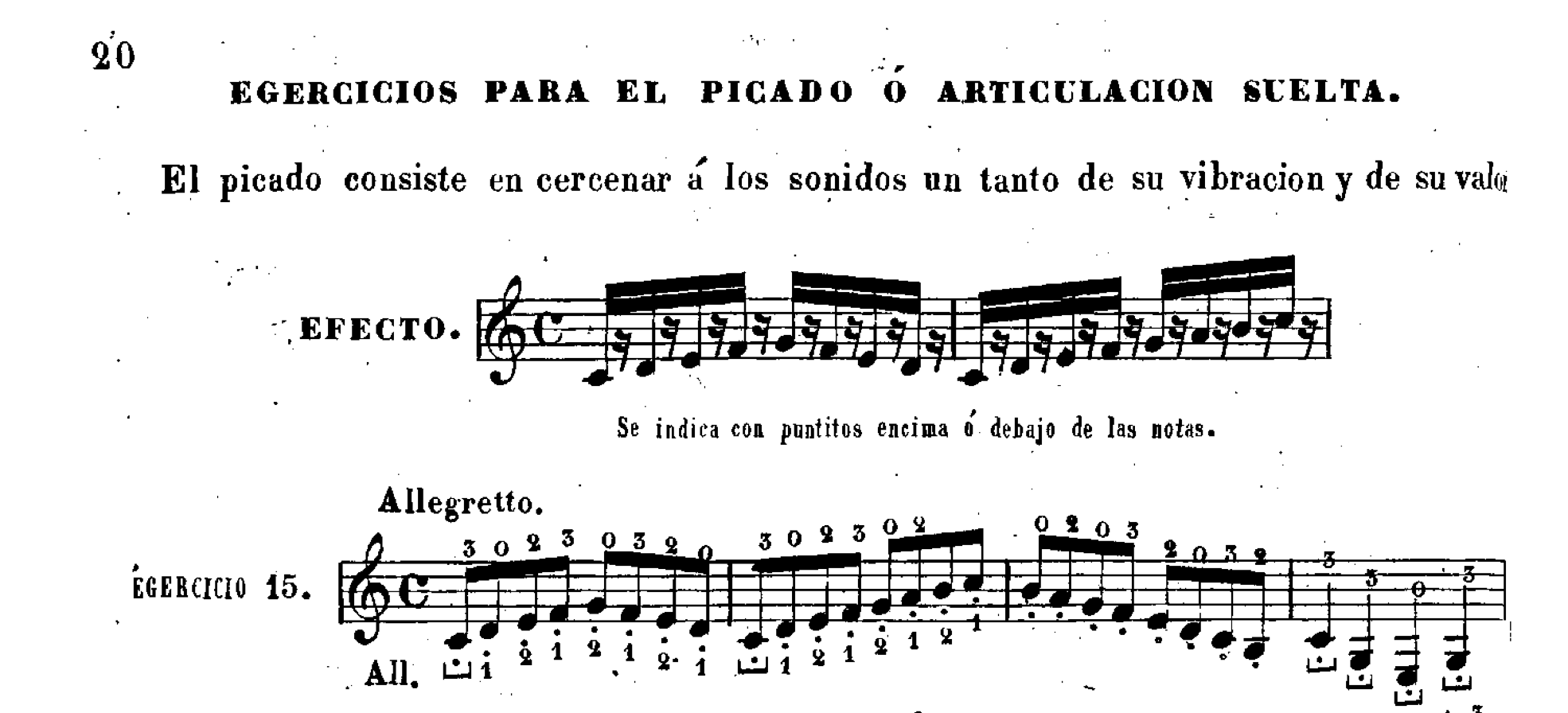
It is simply called "tirando", an essential playing technique using all three fingers and thumb for melodies. Picado is normally "apoyando" and again like other translations of terms there are multiple uses. If we use arpeggio technique tirando but the notes happen to repeat the same note over and over we call it "tremolo" but it is basically an arpeggio "technique". So playing scales rather than slow melodies, it might be ok to call it a "picado" passage, however I would clarify which notes are to be played "apoyando" or "tirando" perhaps it is not either or, but a mixture. Alain Fuacher used to use lower case ima for tirando in all cases, and IMA for apoyando. Other people might not be concerned about that. Gerardo put this in his section of "picado" lessons, however, it was because the sequences were "scalar". In the arpeggio section he showed a mixture of "arpeggio" technique mixed with ligados. In all honesty these two exercises overlap, one could say that Taranta was mixing PICADOS and ligados, or those three finger ami scales were actually a type of arpeggio/tremolo technique.
By contrast, in Sanlucar (pre accident) Gerardo would roll the ami across the strings and the left hand would do arpeggio, scales, tremolos, etc., without stopping the rhythm, basically showing how the ami tirando can be use to express anything you could possibly do with it. The perfect case in the Encuentro was the Rondeña tremolo improvisation on two strings, where a-m were on the 3rd string, and the index on the 4th string, a continuous even roll only broken but the occasional thumb bass note.
In my formative works mel bay book, the A.5 arpeggios are playing scalar lines using ami so a mix of arpeggio and "picado", all done tirando.
|
|
|
|