|
Fawkes -> RE: Wanted: Conde FC28 Bracing diagram (Jan. 28 2026 21:33:38)
|
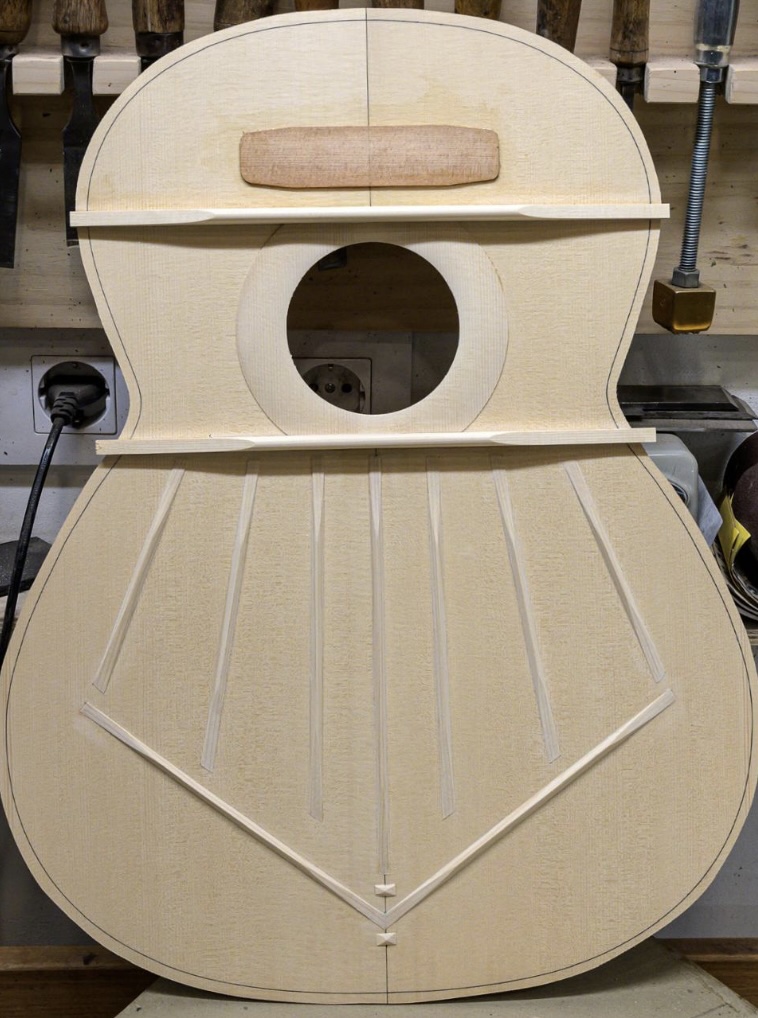
Ethan is not alone in making the point that the layout of the bracing is not a magic bullet. Many luthiers say this, or something near it.
And yet some luthiers think the layout has an effect, for instance many luthiers say the presence or absence of the closing bars seems to have an impact. And surely Santos Hernandez wouldn't have been so methodical in his career-long experiments with bracing layout if he wasn't trying to learn something.
Alan Carruth's comments from his modes/scientific measurement framework provide a way of possibly integrating the conflicting pictures. He talks about balance between the soundboard and bracing being necessary to good outcomes for issues that can be controlled like volume, response, balance, and basic tone. But he admits that a lot of the higher frequency vibrations which contribute to the character of the sound are not predictably controllable by his methods. Although I don't think Carruth has said this explicitly, from what I understand these more subdivided patterns of vibration might well be affected by the layout of the braces.
quote:
ORIGINAL: constructordeguitarras
While the bracing pattern is a starting point, I have to say that it is much less important than people generally seem to think. What may be even more important is how the sound board is graduated in thickness, how the cross section of the fan braces is dimensioned and shaped, how much the ends of the braces are scalloped.... I would wager that any popular "bracing pattern" could be used to give the same result as another by controlling these factors.
|
|
|
|